
Greg Chandler
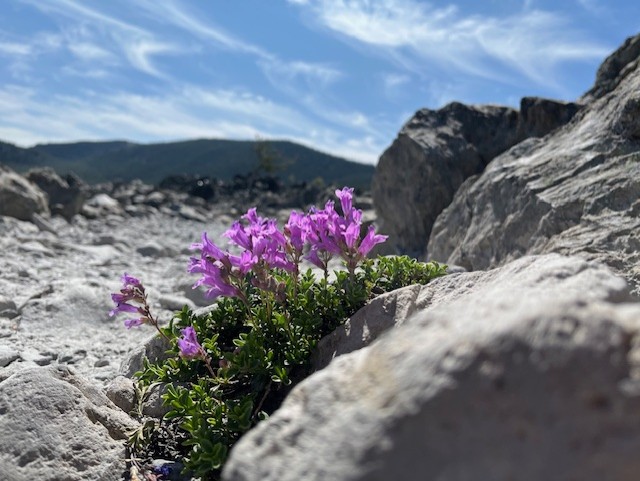
Much of Oregon’s natural history has been influenced by volcanoes. For centuries, various areas of the state have experienced the devastating impact of eruptions that left lifelessness in their wake. Still, they have an eerie beauty. These areas, now filled with obsidian, have been designated as parks to preserve them from encroaching capitalism or home construction. One such area is Newberry National Volcanic Monument. Rising high in the Oregon mountain country, its piles of obsidian stone now lend tourists the opportunity to climb its peak for a spectacular view. Interestingly, amid the canvas of black and gray, a single plant lives, with its purple flowers drawing immediate attention from passersby (see picture). Was its original seed dropped by a bird flying overhead, or did a strong Northwest Pacific storm relocate it in a place it should not be? Only God knows the answer.
Though the little plant had no real choice in the matter, it provides a scene of contemplation for the people of God. Placed in hard circumstances, it has not only survived, it has thrived. The little Philadelphian church in Asia could relate. Centered in the harsh environment of an empire drunk on its own power and a people who considered themselves chosen by God yet rejected His Son, the little church bloomed. This is what the Lord had to say about His church: “I know your works. Behold, I have set before you an open door, which no one is able to shut. I know that you have but little power, and yet you have kept my word and have not denied my name” (Revelation 3:8). From all appearances, its survival and flourishing should not have occurred. Opposition to the group should have long since frightened its members into submission. However, the little church loved its Lord and stayed faithful. In so doing, He promised them eternal occupancy of His temple, as well as the names of God, the city, and their Savior. They just had to hang tight and allow no one to seize their crown (3:11b).
It is easy to dismiss such examples as the little flower as platitudinal, perhaps seeing it as merely “fluff” that has little real-life significance. To do so, however, would miss a major theme cutting through the pages of God’s word: the faithful remnant. God’s people can end up in very unexpected places. Would an old man from Ur have dreamed of trekking to Canaan, Egypt, and back again to Canaan? Would the youngest son of a shepherd have imagined himself as king of Israel? Would twelve boys have dreamed they would grow up to be the ambassadors of the Christ’s message of salvation? God has a unique way of putting people in unexpected places. Even amid captivity for their sins, God expected His people to conduct themselves in such a manner that would reveal a marked distinction between them and their pagan captors. Based on this history, it is no surprise that one of the major lessons taught in the Lord’s Sermon on the Mount is to “let your light shine before others, so that they may see your good works and give glory to your Father who is in heaven” (Matthew 5:16).
American Christians must take this lesson to heart. Though many people throughout the world face a daily threat of persecution for their faith, Americans bask in the freedom of a nation that tolerates religion, promotes freedom of speech, and sometimes even punishes the persecutors. If not careful, the vibrant purple flora begins to subtly blend with the black and gray hues of surrounding culture and the concept of the faithful remnant fades. This, however, cannot be allowed to happen.
There are outward manifestations that should stand in stark contrast to the world: modest clothing, appropriate speech, and a gentle spirit that rejects undue anger are but a few among many. Still, every good outward manifestation must flow from a heart that mimics those ancient believers in Philadelphia. As the Apostle Paul wrote to another church, he stated, “we have the mind of Christ” (I Corinthians 2:16). To shine light into the world means purging those things contrary to godliness; it means removing hypocrisy, secret anger, a backbiting tongue, a prejudicial spirit, and any other deliciously sinful habit that is kept from public view. The followers of the One who knew no guile must put on the garments unstained by guile (I Peter 2:22).
The influence exerted by the children of God is immense; it would likely frighten each believer if they knew its extent. Every day must begin with the determination to let light shine and to keep the darkness at bay. Every day must demonstrate a life that stands in stark contrast to the surrounding lifelessness. Every day, the remnant mentality must be front and center. With the Savior’s strong arm, Christians of this modern era can link arms with the brethren in Philadelphia and look forward to the crown given by Him for faithful service.


